

In this guide
- Why Long Island websites get visits but not calls
- The 7 Long Island SEO services at a glance
- 1. Google Business Profile and Map Pack optimization
- 2. Local SEO: service pages and town pages
- 3. AI SEO for ChatGPT, Gemini, Perplexity and Google AI Overviews
- 4. Technical SEO and a fast, mobile-first website
- 5. SEO content that answers what customers ask
- 6. Reviews and reputation management
- 7. Tracking, reporting and fast follow-up
- Which services to start with, by type of business
- Where Google Ads fits while SEO builds
- Long Island small business SEO checklist
- What the first 90 days should look like
- What SEO services cost on Long Island
- How to choose a Long Island SEO company
- FAQ
- A note from Marcus Becker
- See how Long Island customers find you
Plenty of Long Island small businesses pay for SEO every month and can't point to what it produced. The report shows impressions and "keyword movement," but the phone rings about the same as it did last spring. Usually the work wasn't lazy. The budget went to the wrong services, in the wrong order, aimed at searches that don't bring paying customers.
Search here has also changed shape. A homeowner in Massapequa still types "roof leak repair" into Google, but she also taps the map, reads a few reviews and may ask ChatGPT which roofer to trust before she calls anyone. A patient in Garden City compares orthopedic practices on Google, then asks Gemini which ones take her insurance. Each of those places picks businesses differently, and a small business has to show up in most of them to get the call.
This guide covers the seven Long Island SEO services that matter most for a small business in 2026: what each one is, what it should include, how to tell if you need it and what to ask before you pay. We're a Long Island SEO agency in Hauppauge, so we have a point of view. The advice is the same we'd give a friend who runs a business in Nassau or Suffolk, whether or not they hire us.
Why Long Island websites get visits but not calls
When a small business site gets traffic but few calls, the cause is usually one of three things, and none of them is fixed by publishing more blog posts.
The pages don't match what people searched. Someone who types "emergency plumber Bay Shore" wants a phone number, a sign that you can come quickly and proof that you work in Bay Shore. If they land on a general homepage about quality service since 1998, they leave. Each important search needs a page built for what that person wants.
There's no reason to trust you. Buyers look for reviews that describe real jobs, photos of real work, a license number, an address and the names of the people they'll deal with. Google and AI tools look for the same things. A site with stock photos and no specifics loses to a competitor who shows their work.
Nobody answers fast enough. Calls that roll to voicemail, forms that wait until tomorrow and no way to text all leak customers, especially at night and on weekends, when many people finally have time to deal with a leaking roof or a legal question.
The seven services below fix those problems in order: first get seen, then earn trust, then make sure every inquiry gets answered.
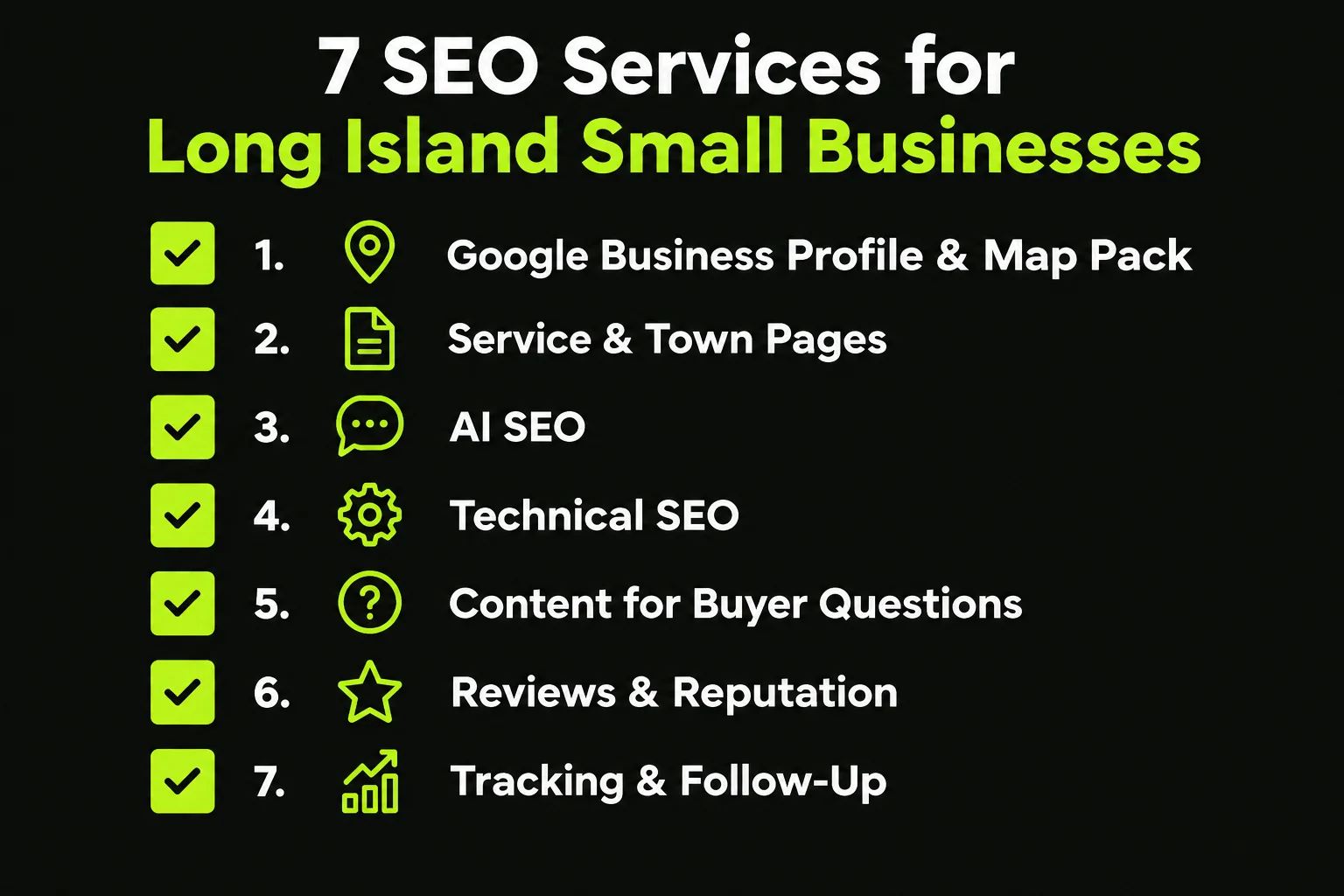
The 7 Long Island SEO services at a glance
Here are the seven services in rough order of impact for most Long Island small businesses, with the problem each one solves:
| Service | What it fixes | When you usually see movement |
|---|---|---|
| 1. Google Business Profile and Map Pack | You're missing from the map box of three businesses | Weeks, for setup fixes |
| 2. Service and town pages | Your site doesn't rank for the specific services you sell | A few months |
| 3. AI SEO | ChatGPT, Gemini and Google's AI name competitors instead of you | Several months |
| 4. Technical SEO | Slow pages, indexing errors and duplicate URLs hold everything back | Weeks, for repairs |
| 5. Content for buyer questions | You have nothing that answers what customers ask before they call | A few months |
| 6. Reviews and reputation | Too few reviews, old reviews or unanswered complaints | Builds month by month |
| 7. Tracking and follow-up | You can't tell which searches brought customers, and slow replies lose them | Immediately, once set up |
The first two bring the quickest wins. The third is where many Long Island competitors haven't started yet. The last one decides whether any of it turns into booked work.
1. Google Business Profile and Map Pack optimization
For most Long Island small businesses, the Map Pack is where calls start, so the Business Profile behind it is the first thing to get right. The Map Pack is the box of three businesses Google shows on a map above the regular results for local searches. If you're not in it, many customers never scroll far enough to find you.
Why the Map Pack decides so many Long Island calls
Google says it ranks local results on three things: relevance, distance and prominence (Google's explanation). Distance does more work here than most owners expect. Nassau is dense, so a dental practice that ranks first in Mineola can drop out of the top three a short drive away in Westbury. Suffolk is long, so a Smithtown plumber rarely shows up for a search made in Southampton. You can't move your office, but you can control relevance and prominence, and that's what this service should do. Our Nassau County and Suffolk County pages go deeper on how each county searches.
What a Google Business Profile service should include
- The right primary category. You get one primary category and up to nine more. The primary one carries the most weight, and "Contractor" is not the same as "Roofing contractor."
- Complete services and an honest service area. List every service you actually offer and set your service area to the towns you really cover, such as "Huntington, Northport, Commack and Smithtown," not all of Suffolk County.
- A clear description. Up to 750 characters, written for people: what you do, where and for whom.
- Real photos, added regularly. Your team, your work and your location, not stock images.
- Industry details. Contractors should show their Nassau or Suffolk County home improvement license number on the site and profile. Doctors and attorneys often need individual practitioner listings handled carefully so they don't compete with the practice listing.
- A real address. Virtual offices and invented suite numbers break Google's guidelines and can get a profile suspended. Service-area businesses can hide their address and still rank.
What to ask before you pay for it
Ask how they'll measure Map Pack visibility. A good answer is a grid rank tracker that checks your position from many points across your service area, because a business can rank first on its own street and tenth two towns over. Ask who will own the profile, too. You should be the owner, with the agency added as a manager, so you never lose access if you change providers. Our Google Maps SEO service is built around both.
2. Local SEO: service pages and town pages
Your Business Profile gets you into the map; your website gets you into the results below it and gives Google the detail it needs to trust your profile. Local SEO is the work of making those pages rank for the specific services and places your customers search.
Why one "Services" page holds you back
The most common problem we see on Long Island small business sites is a single "Services" page that lists ten services in ten bullet points. Google can't rank one thin page for ten different searches. A personal injury firm in Mineola needs separate pages for car accidents, slip and fall cases and construction injuries, because those are different searches from different people. A remodeler needs kitchens, bathrooms and additions on their own pages. Each core service deserves its own URL, title and content.
What a strong service page includes
- One service per page, with the service and your main area in the title, such as "Water Heater Installation in Suffolk County."
- A direct answer near the top: what the service is, who it's for, what affects the cost and how soon you can help.
- Proof: project photos, a short example of the work and reviews that mention that service.
- Local detail that's true: the permits a homeowner in a given town usually needs, what's different about older Capes and split-levels, or how demand shifts on the East End each summer.
- A clear next step: a phone number that dials with one tap on mobile and a short form.
Town pages: when they help and when they hurt
Town pages can work well on Long Island, because people search by the place they live: "orthodontist Rockville Centre," "landscaper St. James." But Google treats near-identical pages with only the town name swapped as doorway pages, which can drag down the whole site (Google's spam policies). Build a town page only when you have something real to say: projects there, reviews from there or a location nearby. Five useful town pages beat fifty copies. Our local SEO service follows that rule.
3. AI SEO for ChatGPT, Gemini, Perplexity and Google AI Overviews
AI SEO is the work of getting your business named, and described accurately, when customers ask AI tools for a recommendation. It's the service most Long Island small businesses don't have yet, and the one changing fastest. More buyers now skip the list of links and ask directly: "Who's a good family dentist in Garden City?" or "Which video production company in Melville does corporate work?" The answer usually names a handful of businesses. Everyone else is invisible in that moment.
How AI tools decide which businesses to name
Each tool builds its answers differently, but they share one habit: they recommend businesses they can confirm from several sources. Google says there are no extra technical requirements for its AI Overviews and AI Mode beyond being indexed and eligible to appear in Search (Google Search Central), so strong regular SEO is the base. ChatGPT's search draws partly on Bing, which makes your Bing Places listing and Bing indexing matter more than most owners assume. Perplexity shows its sources inline, so you can see which directories and articles it trusts in your field.
What AI SEO should include
- Consistent business details everywhere: the same name, address, phone, services and hours on your website, Google Business Profile, Bing Places, Apple Business, Yelp and industry directories. Conflicting details make AI tools less sure of you.
- Answer-first pages that open with a plain answer to a real question, which are easier for AI tools to quote.
- Crawler access. Your robots.txt should allow OAI-SearchBot, the crawler that puts pages in ChatGPT search. Many sites block it by mistake while trying to block GPTBot, which collects training data.
- Reviews with detail. "They fixed our boiler in Commack the night before Thanksgiving" gives an AI tool a service, a town and a reason to name you.
- Local mentions from chambers of commerce, community groups and Long Island publications that confirm you're an active local business.
- Monthly prompt testing: a fixed set of questions your customers would ask, run each month across the major AI tools, with a record of whether you're named and how you're described.
What to ask before you pay for it
Ask to see the prompt list and a sample report. If an agency can't show you which questions it tests and what the AI tools said, it isn't doing AI SEO; it's regular SEO with a new label. If you want a baseline first, an AI visibility audit shows what each major AI tool says about you today and which sources it relies on. Ongoing work runs through our AI SEO service.
4. Technical SEO and a fast, mobile-first website
Technical SEO is the plumbing of your website: customers never see it, but when it's broken nothing else works properly. Most Long Island customers search on their phones, often on the LIRR, in a parking lot or standing in a flooded basement, so a slow or clumsy mobile page loses them before they read a word.
Speed and Core Web Vitals
Google measures page experience with Core Web Vitals: how fast the main content loads (Largest Contentful Paint), how quickly the page responds to a tap (Interaction to Next Paint) and whether the layout jumps around while loading (Cumulative Layout Shift). You can test any page in Google's free PageSpeed Insights. On small business sites, the usual culprits are oversized photos, too many fonts and heavy scripts from chat widgets and trackers. Shrinking a few large images often does more than any other single fix.
What a technical SEO service should fix
- Indexing problems: pages blocked by mistake, missing from Google's index or pointing to the wrong canonical URL. Google Search Console shows most of these for free.
- Duplicate URLs: "www" and "non-www" versions both live, copied town pages, or the same service described on three URLs.
- Redirects: old pages that now go nowhere after a redesign, which quietly throws away rankings you earned.
- Structured data: schema markup that states your business name, address, phone, services and hours in a format search engines read directly.
- JavaScript rendering: many newer sites are built on JavaScript frameworks and website builders. If the content only appears after a script runs, some crawlers, including several AI crawlers, may see an empty page.
What to ask before you pay for it
Ask for the list of issues and which ones get fixed first. A technical audit with 300 "warnings" and no priorities isn't useful. A list of the ten things holding your site back, in order, with who fixes each one, is. Our technical SEO work starts there.
5. SEO content that answers what customers ask
Good SEO content answers the questions your customers ask before they call, in enough detail that Google, AI tools and the customer all trust you. It isn't about posting a blog every week to "stay fresh."
What "helpful content" means in practice
Google's guidance on helpful, people-first content is plain: write for the person searching, show first-hand experience and don't publish pages just to chase keywords. For a small business, that means writing from what you know and your competitors' websites don't: real costs, real timelines, local rules and the questions your front desk hears every day.
Content that works for Long Island small businesses
- Cost guides: "What does a new roof cost on Long Island?" with honest ranges and what changes the price.
- Rule and process explainers: what a homeowner needs before a project in their town, or what happens after a car accident on the Long Island Expressway.
- Insurance and eligibility pages for medical practices, listing the plans you accept and how to check coverage.
- Seasonal guides: spring openings for East End businesses, storm prep for South Shore homeowners, heating checklists before winter.
- Comparisons: repair or replace, Invisalign or braces, drone footage or a full film crew.
- Project and portfolio pages: a real job with photos, the problem, the fix and the town.
What to ask before you pay for it
Ask who writes the content and how they'll learn your business. If the answer is "our writers will research it," expect generic articles. The best content comes from a short interview with you or your team, turned into clear pages by someone who knows SEO. That's how our SEO content writing works.
6. Reviews and reputation management
Reviews shape every stage of local search: they affect your Map Pack position, they're one of the first things a customer reads, and they're a main source AI tools use to describe you. On Long Island, where competing businesses often sit within a mile or two of each other, reviews regularly decide close calls.
What a review service should include
- A simple request process: a text or email with a direct review link, sent right after the job or visit, while the experience is fresh.
- Prompts for detail: asking customers to mention the service and their town leads to reviews that help both rankings and AI visibility.
- A reply to every review: thank good reviews by name and service, and answer bad ones briefly and calmly, with an offer to sort it out offline.
- A steady pace: a few reviews every week looks natural; fifty in one month and then nothing looks odd to Google and to customers.
Rules for medical practices and law firms
Healthcare and legal reviews need extra care. A medical practice should never confirm in a reply that the reviewer is a patient or mention any detail of their care, because privacy rules apply even when the patient posted first. Law firms should keep replies factual and avoid anything that reads as a promise about outcomes, in line with New York's attorney advertising rules.
What to avoid
Never buy reviews, write them yourself, offer discounts for positive ones or send only happy customers to Google while steering unhappy ones elsewhere. Those tactics break Google's policies and the FTC's rule on fake reviews. Asking every customer for honest feedback is allowed, and it works. See our review management service for how we set this up.
7. Tracking, reporting and fast follow-up
Tracking is the service that decides whether the other six pay off, because SEO that brings visitors but can't show calls, forms and booked customers is hard to judge and easy to cancel. Fast follow-up is what turns those visitors into customers.
What good tracking looks like
- Call tracking that shows which calls came from Google search, the Map Pack and your website.
- Form tracking connected to Google Analytics 4, so every inquiry has a source.
- AI traffic measured separately. GA4 now groups many visits from ChatGPT, Gemini and other assistants into an AI Assistant channel, and Bing Webmaster Tools reports how often Copilot cites your pages.
- Map Pack positions across your service area, not one screenshot from the office.
A monthly report you can read in five minutes
Each month you should see calls, forms and booked customers by source, Map Pack positions for the towns you care about, rankings for the services that make you money, how AI tools describe you, and a short list of what happens next. If a report takes an hour to understand, it's built to impress, not to inform. Our AI monitoring report covers the AI side every month.
Why follow-up belongs in an SEO plan
A customer who finds you at 9 p.m. and reaches voicemail usually calls the next business on the list. An AI chat assistant on your site can answer common questions and book appointments around the clock, and an automatic text reply to missed calls keeps new inquiries from going cold. For many Long Island businesses this is the cheapest way to get more customers out of the traffic they already have. See AI chat and instant follow-up.
Which services to start with, by type of business
The order above fits most businesses, but the first priorities shift by industry. Here's where we usually start for the kinds of businesses we work with most:
| Business type | Start with | Why |
|---|---|---|
| Contractors and home services | Business Profile, one page per service, a review request after every job | Most calls come from the map and "near me" searches, and many are urgent |
| Doctors and medical practices | Provider pages, insurance pages, practitioner listings, privacy-safe review replies | Patients choose on insurance, availability and reviews, often between practices a mile apart |
| Law firms | Practice-area pages, attorney bios, after-hours intake | Clients research carefully, then contact the firm that answers first |
| Video production companies | Portfolio pages by project type, YouTube and Vimeo pages, AI SEO for vendor shortlists | Buyers are marketing teams who compare reels and ask AI tools for shortlists |
| Restaurants, shops and other local businesses | Business Profile, photos, current hours, menus or products | Decisions are quick and usually made on the map |
If you're not sure where your business fits, start with the Business Profile and your top three services, because those almost always pay off first. We go deeper for contractors, medical practices, law firms and video production companies.
Where Google Ads fits while SEO builds
Google Ads buys visibility today while SEO builds visibility that lasts, so many small businesses run both for the first few months. Ads make the most sense when you need calls immediately, when you're launching a new service or town, or when the organic results for your main search are crowded with directories. Some home service companies and law firms can also use Local Services Ads, which charge per lead rather than per click. Ads stop the day you stop paying, though, so treat them as a bridge, not a replacement. Our guide to Google Ads vs. SEO walks through the trade-offs, and our Google Ads team can run both together.
Long Island small business SEO checklist
Use this checklist to see where your business stands today. Anything marked "No" is a good place to start.
| Area | What to check | Yes / No |
|---|---|---|
| Google Business Profile | Correct primary category, all services listed, real address, service area set to the towns you cover | |
| Map Pack | You know your position across your whole service area, not just near your office | |
| Service pages | One page per core service, each with a direct answer, local detail and proof | |
| Town pages | Only where you have real work or reviews, each one different | |
| AI search | Your business comes up when you ask ChatGPT and Google's AI about your service in your town | |
| Listings | Same name, address and phone on Google, Bing, Apple, Yelp and your industry directories | |
| Technical | Mobile pages load fast, no indexing errors in Search Console | |
| Reviews | New, detailed reviews every month, all answered | |
| Tracking | Calls and forms tracked by source, AI traffic visible in GA4 | |
| Follow-up | Missed calls and after-hours forms get an instant reply |
What the first 90 days should look like
A good SEO provider shows you the plan early, so you can judge the work before the results arrive. For a typical Long Island small business, the first three months look like this:
- Month 1: baseline and foundations. Record where you stand today (Map Pack positions across your towns, rankings, what AI tools say, calls and forms), fix the Business Profile, repair the technical problems that block indexing and set up call and form tracking.
- Month 2: pages and listings. Build or rewrite your core service pages, clean up your listings on Google, Bing, Apple and your industry directories, and start a steady review request routine.
- Month 3: content and AI visibility. Publish answers to the questions your customers ask most, add town pages only where you have real work to show, and run the first monthly round of AI prompt testing.
By the end of month three you should be able to see what changed against the baseline, even while competitive rankings are still climbing. If you can't, ask why. You can see the kind of work we do for Long Island businesses in our case studies.
What SEO services cost on Long Island
What you pay depends on how competitive your service is, how many services and towns you want to rank for, the condition of your website and how much content is needed. A single-office practice in Patchogue needs less than a law firm competing across both counties. Our own plans are Ignite at $1,000 a month, Takeover at $1,500 a month and The Juggernaut from $2,500 a month, with the full scope in writing before you sign; see pricing for what each includes.
Be wary of packages that promise everything for a few hundred dollars a month. Something has to give at that price, and it's usually the work that matters most: real service pages, review systems and tracking. Be just as wary of long contracts with no clear deliverables. You should know what will happen in the first 30 days and how you'll measure it.
How to choose a Long Island SEO company
The fastest way to judge an SEO company is to ask a few specific questions and listen for specific answers:
- Where's your office? A real Long Island address you can visit is a good sign.
- What will you do in the first 30 days? Expect a concrete plan: audit, profile fixes, technical repairs and a page plan.
- How do you handle AI search? Look for listings work, answer-first content, crawler checks and monthly prompt testing.
- What do you report on? Calls, forms and booked customers should be in the report, not just traffic.
- Who owns my accounts? You should own your Business Profile, analytics and website.
Walk away from anyone who promises a #1 spot by a certain date, asks for a long contract with no written deliverables, sends reports with no calls or forms in them, or keeps your Business Profile or website in the agency's name.
For more questions to ask, read our guide to choosing a Long Island marketing agency.
FAQ
Start with your Google Business Profile and your core service pages. Together they drive the Map Pack and local results, which is where most local calls begin. Technical fixes usually happen alongside them. AI SEO, content and reviews build on that foundation, and tracking shows which parts are producing customers.
Business Profile and technical fixes can move things within weeks. Competitive services in busy markets like Garden City, Huntington or Melville usually take several months of steady work. Ask any provider to record a baseline in the first month, so you can see exactly what changed and when.
They overlap. Local SEO focuses on Google search and the Map Pack. AI SEO focuses on being named in ChatGPT, Gemini, Perplexity and Google's AI answers. Both depend on consistent business details, strong pages and good reviews, so solid local SEO is the foundation, and AI SEO adds crawler access, broader listings and prompt testing.
No. Google and the AI companies decide their own results, and they shift with each searcher's location and wording. A provider promising a fixed position is guessing or measuring from one convenient spot. A good provider commits to clear work on what you control and reports honestly on what it produced.
No. Build strong service pages first, then add town pages only where you have real projects, reviews or a nearby location. Pages that only swap the town name can be treated as doorway pages and hurt the whole site. A few useful town pages outperform dozens of thin ones.
Often, yes. Nassau is dense, so map results change within a mile or two and competition is block by block. Suffolk is long, so distance limits how far one location can rank, and East End businesses also deal with a short, intense season. The services are the same; the priorities and towns differ.
A note from Marcus Becker
Every plan we build starts with one question: which searches bring you paying customers? Everything on this list serves that question. If you'd like a straight answer about where your business stands on Google, the map and AI search, call us at (631) 708-3375 or book a call. If we don't think we can help, we'll tell you that too.
See how Long Island customers find you
Your next customer is already searching Google and asking AI tools who to call. Start with the free readiness check, or talk to us about the services and towns that matter most to your business.